Postgraduate Student Finance Explained: Loans, Funding and How to Apply

If you’re considering studying for a master's degree or PhD, one thing you’ll need to think about is how you’re going to pay for it. Postgraduate student finance can help cover the cost, but it’s important to understand how it differs from undergrad funding.
Eligible students can apply for postgraduate loans for tuition fees and living expenses, as well as other options including bursaries and scholarships.
In this guide, we’ll explain what postgraduate student finance is available for the 2026/27 academic year, how much funding you might be able to receive, how to apply and how you’ll eventually start repaying your loans.
What Postgraduate Student Finance Is Available?#
There are two main types of postgraduate student loan available in England, depending on your course: the Postgraduate Master's Loan and the Postgraduate Doctoral Loan, both provided by Student Finance England.
Here we’ve provided a quick overview of the main funding types you can consider for postgrad study:
Funding type | What it offers |
Postgraduate Master's Loan | Up to £13,206 towards tuition fees and living costs for courses starting in 2026/27 |
Postgraduate Doctoral Loan | Up to £31,122 towards tuition fees and living costs for doctoral courses starting in 2026/27 |
Scholarships and bursaries | Funding from universities and other organisations, usually without repayment |
Research studentships | Funding for research degrees that may cover tuition fees and provide a living allowance |
Other support | Financial assistance such as Disabled Students' Allowance, employer sponsorship and university hardship funds |
Unlike undergraduate student finance, postgrad loans in England are typically provided as a single amount towards the overall cost of your studies, rather than being separated into tuition loans and maintenance loans.
Eligibility does vary based on where you live, but for the purposes of this guide we’ll focus on Student Finance England, and briefly cover options for other nations later on.
Postgraduate Master's Loans Explained#
If you're looking into student finance for a master's degree, the Postgraduate Master's Loan from Student Finance England can help pay for full- or part-time MSc, MA, MBA and MRes programmes.
How Much Is the Postgraduate Master's Loan?#
If you’re studying a postgraduate master’s course starting in August 2026 or later, you can borrow up to £13,206. This works slightly differently to undergrad funding, so here are the important facts:
- This amount is for the full course, so if you’re studying a two-year master’s, the loan will be divided equally between the two years.
- The postgrad loan isn’t means-tested, so you’re eligible for the same amount regardless of your income or your parents’ income.
- You can choose to borrow less if you don’t need the full amount.
- The loan is paid directly to you, unlike undergraduate tuition loans which are paid straight to your uni.
Tuition fees for master’s degrees vary significantly (more so than undergrad courses), so while the loan may cover the full cost of your degree, it could also leave you with a substantial amount you’ll need to pay out of pocket. Also, note that payments are made in three instalments per academic year, so you won’t get a lump sum to help cover accommodation deposits or other upfront costs.
Who Is Eligible for a Master's Loan?#
To qualify for a Postgraduate Master’s Loan through Student Finance England, you’ll need to meet the following conditions:
- Under 60 years old when you start your course
- Normally live in England (and meet nationality and residency requirements)
- Don’t already hold a master’s degree (or higher) qualification
- Studying a full, standalone master’s degree worth at least 180 credits at an eligible institution
- Studying an eligible course lasting one or two years full-time, or two to four years part-time, subject to course duration requirements
There are exceptions to some of these requirements regarding previous study, residency and personal circumstances. If you’re planning to apply for a Postgraduate Master’s Loan, check out the full eligibility criteria and guidance.
Do You Get a Maintenance Loan for a Master's Degree?#
In England, there’s no separate loan specifically for living costs when studying a master’s degree. Instead, the Postgraduate Master’s Loan contributes to both your day-to-day expenses and your course tuition fees. As the money is paid directly to you rather than the university, it’s up to you how you spend it.
Let’s see what this might look like for a hypothetical one-year master’s degree in 2026/27, with tuition fees of £9,500 and assuming you’ve borrowed the maximum available:
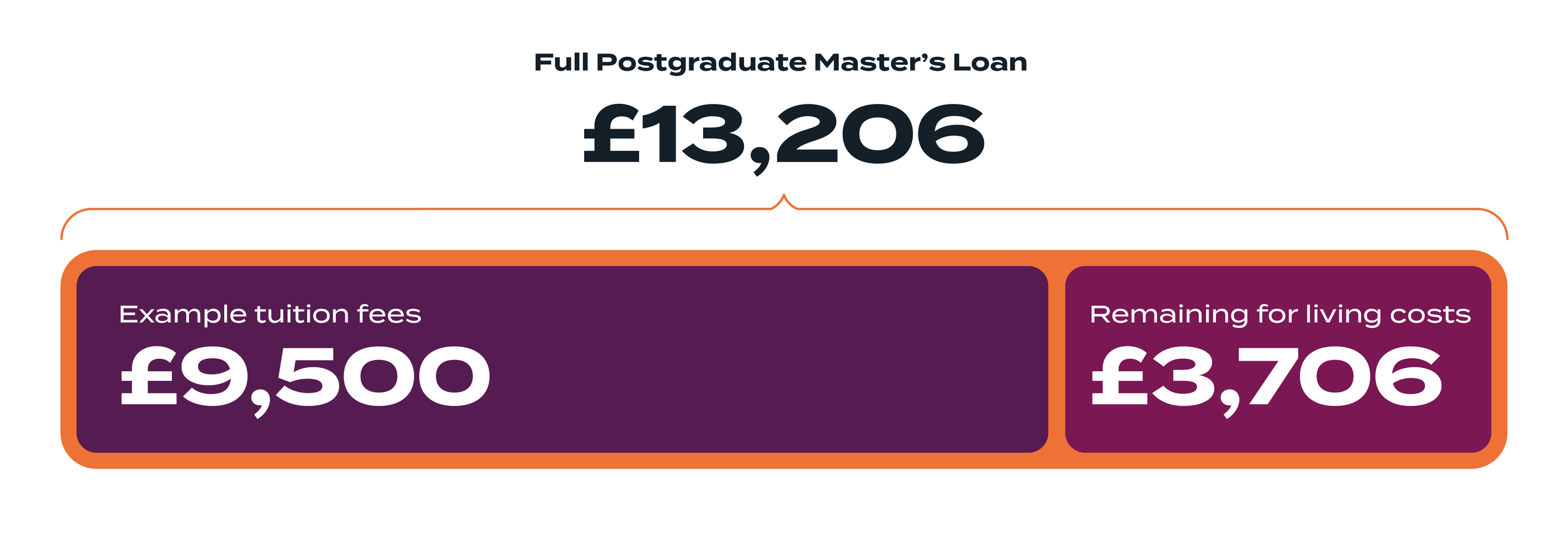
In this example, you'd have £3,706 left to cover accommodation, food, transport and other expenses throughout the academic year. That won’t stretch too far (particularly in high-cost-of-living areas), so you’ll most likely need another form of funding, such as scholarships, savings or part-time work.
It’s worth figuring out a realistic budget before you accept a postgraduate place at uni; our guide to how much money you’ll need at uni is a great place to start understanding the expenses involved. You can also explore student accommodation options on StudentCrowd to compare prices and see what other students think about value for money.
Postgraduate Doctoral Loans Explained#
For PhD programmes and other doctoral qualifications, you may be eligible for a Postgraduate Doctoral Loan, which is structured a little differently. For courses starting on or after 1 August 2026, Student Finance England offers up to £31,122 towards tuition fees and living costs. As with the master’s loan, this amount is for the entire course, not per year. However, it isn’t paid as a lump sum, and is instead paid in instalments divided equally across your years of study.
To qualify, you typically need to meet these requirements:
- Under 60 years old when you start your course
- Meet relevant residency requirements
- Don’t already hold a doctoral degree
- Studying an eligible qualification lasting three to eight years
One other restriction to be aware of is that if you’re going to receive funding from a Research Council, you won’t be eligible for the Postgraduate Doctoral Loan. Some funded PhD studentships have the potential to offer more financial support than government loans, sometimes covering tuition fees as well as providing a living allowance. If you’re looking into doctoral programmes, it’s worth looking into both options.
You can find the full requirements on the government's Postgraduate Doctoral Loan page.
How and When to Apply for Postgraduate Student Finance#
If you previously applied for undergrad student loans through Student Finance England, your postgrad application will feel very familiar. Even if it’s your first time applying for funding, the process is fairly straightforward.
When Do Postgraduate Student Finance Applications Open?#
Applications for the 2026/27 academic year opened on 22 July 2026, so if you’re starting a postgrad course this year you can apply now.
You don’t necessarily need to apply before your course begins (unless you absolutely need the loan to cover your tuition fees). You can actually apply for a Postgraduate Master’s Loan up to nine months after the first day of your final academic year, so you’ll have the option if your financial situation changes while you’re studying. However, applying early gives Student Finance England more time to process your application, and means you’re more likely to get your payments on time.
How to Apply for a Postgraduate Loan#
To apply for postgraduate funding through Student Finance England, follow these steps:
1. Check your eligibility and make sure both you and your course meet the relevant requirements
2. Make sure you have your personal details and course/university information to hand.
3. Sign in to Student Finance England, either using your existing account (if you’ve previously received student finance) or creating a new one.
4. Complete your application by selecting the appropriate loan and providing the required information.
5. Submit any required supporting evidence and additional documents.
Once Student Finance England has approved your loan, you can check the payment schedule through your account. You only need to apply once for a postgraduate loan, whether you're studying for a master's or doctoral degree.
Can You Apply for a Master's Loan Before Being Accepted?#
If you’ve already decided on a course, you can normally start your application before your university place is officially confirmed. Note that if you do need to change your university or course for whatever reason, you’ll need to update your details with Student Finance England. Your first payment won’t be released until SFE can confirm your registration with your uni.
If you haven’t decided where to study yet, take a look at our guide on applying for a master’s degree for advice on choosing a course and preparing your application.
How Does Postgraduate Loan Repayment Work?#
Postgraduate loans work similarly to undergraduate loans in one important respect: repayments are based on your earnings, not how much you borrowed.
When Do You Start Repaying a Postgraduate Loan?#
Master's Loan repayments normally begin from the April after you finish or leave your course, provided you're earning above the repayment threshold (note that different rules can apply to part-time students). For doctoral students, this will either be the same, or the April four years after starting their course (whichever comes first).
For the 2026/27 tax year, the postgraduate repayment threshold is £21,000 per year, and you will repay 6% of your income above this amount. For example, if you earn £30,000 annually:
Calculation | Amount |
Annual salary | £30,000 |
Income above threshold | £9,000 |
Annual repayment (6%) | £540 |
Monthly repayment | £45 |
As with undergrad loans, repayments will normally be deducted directly from your salary if you’re employed, or if you’re self-employed payments will be calculated through Self Assessment. Unlike other types of loans, repayments stop in the event that your income falls below the earnings threshold.
How Much Interest Do Postgraduate Loans Charge?#
Although you don’t need to start making repayments while you’re still studying, interest will start accumulating on your loan as soon as you receive your first loan payment. The interest rate is normally calculated using the Retail Price Index (RPI), a measure of inflation, plus 3%. However, the postgrad loan interest rate is currently capped by the government at 6% until 31 August 2027.
Although your owed amount may increase if interest outpaces what you’re paying off, your monthly repayments will only ever be calculated based on your income rather than the outstanding balance. Additionally, any outstanding balance will normally be written off 30 years after the April you were first due to start repaying.
What If You Already Have an Undergraduate Student Loan?#
If you have an undergraduate student loan and a postgraduate loan, you’ll need to make repayments on both simultaneously. Each has its own repayment threshold and rate, which makes it a little more complex to calculate what you’ll pay each month.
For example, a graduate with a Plan 2 undergraduate loan and a Postgraduate Loan repays 9% of earnings above the Plan 2 threshold, plus 6% above the postgraduate threshold. For 2026/27, these thresholds are £29,385 and £21,000 respectively.
This means someone earning £30,000 annually would repay approximately £45 per month towards their postgraduate loan and £4.61 towards their undergraduate loan, bringing their total monthly repayments to around £50. Note that factors such as how often you’re paid will also affect the exact amount.
You can check the most up-to-date thresholds on the gov.uk website.
How to Fund a Master's Degree: Other Options#
Postgraduate study isn’t cheap; while a student loan can help cover the cost, it likely won’t be enough to live off without ways to supplement your income. Fortunately, there are other master's funding options worth exploring.
University Scholarships and Bursaries#
Many unis offer a range of bursaries and scholarships for postgraduate students, with eligibility often based on academic achievement or financial circumstances. These don’t typically need to be repaid, so can offer a good way to study without taking on more debt.
To find available scholarships and bursaries, check your university’s funding pages, as well as specific departmental scholarships that might not appear on the main page.
Research Studentships#
Studentships are a common funding option for research students, such as PhD candidates. These can cover tuition fees, research costs and a stipend for living costs, but unlike student loans they don’t normally need to be repaid.
Research Council funding is a major source of financial support for doctoral programmes, but universities also provide their own funded research positions, so check both options when considering a PhD or similar research programme. Remember that some funding arrangements (including Research Council studentships) may exclude you from postgraduate student loans.
Employer Sponsorship#
Depending on your career and industry, your employer may be willing and able to contribute towards a master’s degree that helps you progress in your role or prepare for a more senior position. Some employers will cover tuition fees, while others may just offer partial funding. If a master’s degree would help develop skills relevant to your role, it’s worth discussing the possibilities with your employer.
Charities and Educational Trusts#
Some charities, foundations and educational trusts provide postgraduate funding for students studying particular subjects or pursuing certain careers. It’s worth noting that the eligibility criteria can be quite restrictive, so you’ll need to research to find out which ones are available to you.
These individual grants are typically fairly small, but as a postgrad student they can still help cover your tuition fees or living expenses.
Part-Time Work and Savings#
Of course, you can also cover some of your postgraduate study costs using savings (for example working for a few years between your undergraduate and master’s degree), or by working part-time alongside your studies.
However, note that postgraduate study can be significantly more demanding than undergraduate study, so working while studying will require careful planning and discipline. Studying part-time may make it easier to continue working and earning money while completing your qualification.
Postgraduate Student Finance in Wales, Scotland and Northern Ireland#
In this guide we’ve mainly focused on postgrad student finance in England, but eligibility is actually based on where you normally live (not where you’ll be studying). Finance availability works differently across the UK, so check the arrangements below for your home nation:
- Wales:Student Finance Wales offers postgraduate Master's and Doctoral Loans, with different amounts and eligibility requirements.
- Scotland: The Student Awards Agency Scotland (SAAS) provides funding towards tuition fees and living costs for eligible postgrad students.
- Northern Ireland:Student Finance Northern Ireland offers postgraduate tuition fee loans, with different arrangements from England.
Wherever you live, it’s essential to check the specific rules for the year you’re applying, as both funding amounts and eligibility requirements can change from year to year.
Frequently Asked Questions#
Does Student Finance Cover All Postgraduate Courses?#
No, some postgraduate qualifications require alternative funding arrangements. The standard Postgraduate Master’s Loan in England is intended for standalone master’s degrees, but not other postgraduate certificates or diplomas. If you’re not sure whether a specific course is eligible for funding, check with the university.
Is a PGCE Funded Through Undergraduate or Postgraduate Student Finance?#
While a Postgraduate Certificate in Education (PGCE) is indeed a postgraduate-level qualification as the name suggests, these courses generally use undergraduate-style funding options rather than a Master’s Loan. For eligible courses starting from January 2027, applicants will go through the new Lifelong Learning Entitlement (LLE) scheme.
Can You Get a Master's Loan If You Already Have a Master's Degree?#
Generally, it isn’t possible to qualify for a Postgraduate Master’s Loan if you already have a master’s degree, or any equivalent or higher qualification. There may be rare exceptions, however.
Can Part-Time Students Get Postgraduate Student Finance?#
Yes, provided they meet the relevant eligibility and course duration requirements, students on part-time master's and doctoral courses can apply for postgraduate student finance.
Can You Get Postgraduate Finance for an Online Master's Degree?#
Yes, some distance-learning master’s courses are eligible for postgraduate student funding. However, it’s important to check the official eligibility guidance, particularly if you intend to study while living outside of the UK.
Conclusion#
For most people, postgraduate study is a significant financial commitment, but knowing about the various ways to cover some of the cost makes it more manageable. Before you apply or accept a place on a master’s degree or PhD programme, make sure you confirm which funding you’re eligible for and how much it will cost in total:
- Compare tuition fees for each course
- Check living costs for your chosen uni’s area
- Investigate scholarships and bursaries, including eligibility requirements
That way, you’ll have a much better idea of exactly what your postgrad study will cost, and how you’re going to pay for it.