Edinburgh or Glasgow: Which University City Is Right for You?

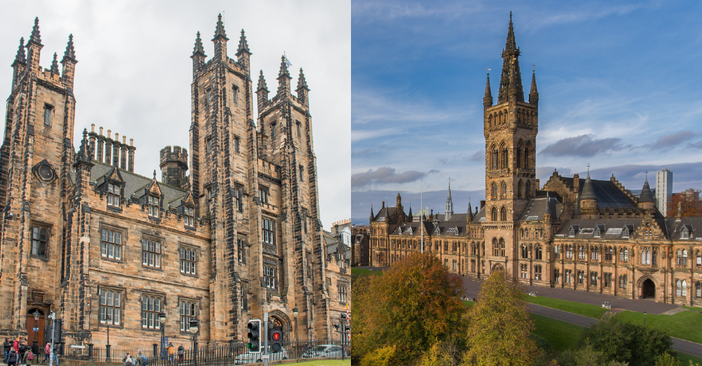
Edinburgh and Glasgow are two large, popular cities in Scotland, each with a large student community and its own Russell Group university: the University of Edinburgh and University of Glasgow. Both are prestigious institutions consistently ranking among the top 100 universities globally, but can differ significantly in terms of the student experience.
Deciding on your university isn’t just about picking the highest-ranked institution; it’s also important to consider what you want out of your uni experience, and what each university and city’s unique strengths are. Using StudentCrowd’s data, sourced from real students in each city, we can identify some of the important differences between Edinburgh and Glasgow:
- Glasgow scores slightly higher overall on StudentCrowd, with 4.35 out of 5 compared with Edinburgh's 4.25
- Edinburgh performs particularly well for communication and transparency, shared social and study spaces, and building safety and security, while Glasgow scores higher for heating and water supply, room size and comfort, and proximity to university
- Glasgow is a little cheaper overall, with the cost of living including rent estimated to be around 8.6% lower than Edinburgh
- Edinburgh ranks considerably higher in the latest global university rankings, although both universities are highly regarded in the UK and internationally
- Edinburgh has a higher proportion of international undergraduate students, with international students making up 31% of first-degree students compared with 18% at Glasgow
- Tuition fees are broadly the same at both universities (fees paid by SAAS for eligible Scottish undergrads, or £9,790 per year for students in England, Wales or Northern Ireland)
- Both universities have similarly strong graduate outcomes, indicating that course choice is a bigger factor
In this guide, we'll explore the key differences in more detail, and help you decide which city is right for you based on factors such as accommodation, cost of living, and student lifestyle.
Best for… | City |
Global ranking | Edinburgh |
Student satisfaction | Glasgow |
Budget-conscious students | Glasgow |
Nearby shops and amenities | Edinburgh |
Accommodation | Depends |
Graduate prospects | Both |
Quick Comparison#
Before we dive into specific areas of comparison, here we've provided a high-level, side-by-side comparison of Edinburgh and Glasgow based on various metrics. The two cities and universities are evenly matched in a few areas, with slight differences in others.
On paper, Edinburgh has the higher rankings, but that doesn't make it the automatic winner. Glasgow scores marginally better in StudentCrowd's student reviews, is cheaper to live in and produces very similar graduate outcomes.
Category | Edinburgh | Glasgow | Notes |
Russell Group? | Yes | Yes | Both are ancient Russell Group universities. |
QS World Ranking 2027 | 35th | 80th | Edinburgh has the higher global ranking. |
THE World University Ranking 2026 | 29th | 84th | Edinburgh has the higher global ranking. |
Complete University Guide | 19th in UK | 29th in UK | Edinburgh has the higher UK ranking. |
StudentCrowd accommodation score | 4.25 | 4.35 | Glasgow scores slightly higher in StudentCrowd's reviews. |
Student population | ~39,000 | ~38,700 | Virtually identical in size. |
International students | ~15,600 full-time international students (44%) | ~13,365 full-time international students (39%) | Edinburgh has more international students, and a higher proportion of international students. |
2026/27 undergraduate tuition fees | Paid for by SAAS for eligible Scottish students, £9,790 per year for rest of UK | Paid for by SAAS for eligible Scottish students, £9,790 per year for rest of UK | No difference. |
Typical accommodation cost | University halls: £231.87/week | University halls: £189.10/week | Glasgow is slightly cheaper on average, while Edinburgh has a wider range in cost. |
Graduate outcomes | 93% | 92% | Both perform similarly for graduate outcomes. |
What Student Reviews Reveal About Edinburgh vs Glasgow#
StudentCrowd's review data indicates that student experiences in both Edinburgh and Glasgow are broadly positive, but there are some clear differences in what each city does best. Edinburgh performs particularly well for shared spaces, communication and overall value, while Glasgow stands out for room comfort, heating and proximity to university.
Below we can see some of the most significant differences between the two cities, as well as how they compare to other accommodation across the UK.
Category | Edinburgh | Glasgow | UK average |
Heating & water supply | 2.42 | 3.04 | 2.45 |
Proximity to university | 4.41 | 4.59 | 4.66 |
Room size & comfort | 4.50 | 4.65 | 4.50 |
Bathroom & hygiene | 2.97 | 3.15 | 3.11 |
Shared social & study spaces | 4.58 | 4.37 | 4.24 |
Communication & transparency | 3.67 | 3.22 | 3.08 |
Overall value for money | 4.42 | 4.36 | 4.34 |
For Edinburgh, some of the strongest results relate to communal areas and how accommodation is managed. Shared social and study spaces score 4.58, comfortably above both Glasgow and the UK average, while communication and transparency also performs particularly well. Students also rate Edinburgh slightly higher for overall value for money, despite the city generally being more expensive to live in. One reviewer praised the “sense of community” and described their accommodation as “excellent value for what you get”.
On the other hand, Glasgow's biggest advantages are comfort and convenience. It scores significantly better for heating and water supply, as well as slightly higher for room size and comfort and bathroom and hygiene standards. Students also rated their accommodation higher for proximity to university, meaning less time spent commuting to classes or extracurriculars. As one reviewer put it, their accommodation was “close to the uni and city centre” while also offering “a very good environment to make friends and study”.
Additionally, there are many areas where the cities are closely matched, including staff professionalism, community experience and events and activities. Therefore, it's not so much a case of one city having better accommodation; rather, it's about their different strengths, and which are more important for your university experience.
University Profiles#
University of Edinburgh#
Founded in 1583, the University of Edinburgh is one of Scotland's four ancient universities and part of the Russell Group, and is divided into three main colleges:
- Arts, Humanities and Social Sciences
- Medicine and Veterinary Medicine
- Science and Engineering
These three colleges cover a wide range of subjects and highly regarded courses, including medicine, law, business, humanities and the social sciences.
Edinburgh is particularly strong on research, ranking 4th in the UK for research power in the Research Excellence Framework (REF) 2021; it was also the highest-ranked university in Scotland. Almost 90% of its research was graded as world-leading or internationally excellent, with 21 of the 28 assessed disciplines ranking in the UK's top five. Edinburgh notably ranked first place in the UK for disciplines such as Informatics and Computer Science.
The university's research and teaching facilities are spread across a few different areas, rather than being concentrated in a single campus. Depending on your course choice, you might be spending more time around the Central Area (near Old Town), or at King's Buildings (around two miles south of the city centre). This can mean more time commuting, but might be preferable if you like the idea of spending more time in the city itself.
University of Glasgow#
The University of Glasgow is even older (one of the oldest universities in the world, in fact), having been founded in 1451. It is also a member of the Russell Group, and another of Scotland's four ancient universities. Glasgow's four main colleges are:
- Arts and Humanities
- Medical, Veterinary and Life Sciences
- Science and Engineering
- Social Sciences
These colleges comprise schools covering business, medicine, law, computer science, engineering, political science, and more.
Much like Edinburgh, Glasgow's research is a big reason for its strong reputation. In REF 2021, 93.1% of its research was judged to be world-leading or internationally excellent, while Times Higher Education placed the university joint 13th in the UK based on its overall REF results. Glasgow also ranked first in Scotland for research outputs and GPA.
Compared to Edinburgh's widely spread university buildings, the majority of teaching and research at Glasgow is concentrated in the main Gilmorehill campus, offering a compact, campus-style environment with all of the shops, restaurants and amenities you might need. If you're looking for more of a distinct campus feel while still having easy access to a major city, Glasgow might be the better option for you.
International Students#
Both of these Scottish universities have large and diverse international communities. Around 15,600 of Edinburgh's students are international, compared with around 13,400 at Glasgow.
The main difference is in how international students are distributed across the student body. When looking only at undergraduates, around 31% of students at Edinburgh are international students, significantly higher than Glasgow's 18% (note that the University of Edinburgh is also aiming to increase this percentage to 50% of students). Conversely, an incredible 84% of Glasgow's postgraduate taught students are international students, marking a striking difference with the undergraduate population.
International students at either university will be part of a diverse community with students from all over the world, with plenty of support to help you settle into university life in Scotland.
Tuition Fees and Cost of Living#
Before we get into specifics, it's important to be aware that tuition fees work a little differently in Scotland to the rest of the UK. At both the University of Edinburgh and the University of Glasgow, the standard annual tuition fee for 2026/27 undergraduates is £1,820. However, if you're an eligible student living in Scotland and applying for your first full-time degree, you can apply to have your tuition paid in full through SAAS (a Scottish Government body providing financial assistance for students).
Students from the rest of the UK (England, Wales and Northern Ireland) will have to pay the standard UK tuition fee of £9,790 per year for 2026/27; note that this fee may increase in the future as the tuition fee cap is raised.
International fees vary by course at both universities, but for international students Edinburgh tends to be a little more expensive. For 2026/27, Glasgow charges £27,720 for Arts and Social Sciences and £33,210 for Science and Engineering, while comparable Edinburgh courses can cost around £29,600 for classroom-based subjects and £38,900 for science-based courses. Check the fees for similar courses at each uni before applying, as there can be significant differences that really add up over three or more years.
Accommodation is another important difference. University accommodation in Edinburgh ranges from around £88-£389 per week for self-catered rooms, with catered options averaging £279 per week. At Glasgow, university accommodation typically ranges from around £133-£250 per week, indicating that while Edinburgh provides a wider choice of options, Glasgow has cheaper options overall.
That reflects the wider cost-of-living picture too. Estimates suggest that living costs including rent are around 8.6% lower in Glasgow than Edinburgh. Your actual spending will depend heavily on where you live and your lifestyle, but if keeping day-to-day costs down is a priority, Glasgow is generally the more affordable choice. If you want to see what your personal budget might look like in each city, check out the UCAS Budget Calculator.
Accommodation and Student Experience#
Overall, student reviews suggest that accommodation options are fairly good across both cities, but Edinburgh and Glasgow each pull ahead in specific areas.
Glasgow does better in terms of the fundamentals of accommodation and the rooms themselves. It scores higher for heating and water supply (3.04 vs 2.42), room size and comfort (4.65 vs 4.50) and proximity to university (4.59 vs 4.41). While Glasgow wins on heating, the better insulation can be a double-edged sword in the summer, with one student saying about their accommodation: “everything is perfect, just it's very hot in summer”. Edinburgh performs better on communal areas and building facilities. It scores higher for shared social and study spaces (4.58 vs 4.37), in-flat kitchen quality (3.90 vs 3.62), building safety and security (4.39 vs 4.13) and maintenance responsiveness (4.33 vs 4.17). Edinburgh also has a significant advantage for communication and transparency from accommodation staff (3.67 vs 3.22).
Despite Edinburgh being more expensive overall, students in both cities rate value for money similarly. Edinburgh scores 4.42 for overall value for money, compared with 4.36 in Glasgow, and complaints about overpriced accommodation are similarly rare across both cities.
One practical difference worth noting is that Edinburgh offers an accommodation guarantee for eligible incoming undergraduate students who apply before the deadline, reducing the risk of having to scramble for accommodation at the last minute. Glasgow doesn't offer a similar unconditional guarantee, so it's more important to apply early to ensure you get accommodation you're happy with.
Student Life and Culture#
Both cities have plenty going on outside university, but they offer quite different cultural experiences.
As well as the atmosphere of a historic capital, Edinburgh boasts one of the world's most famous arts scenes. The city's medieval Old Town and Georgian New Town are a UNESCO World Heritage Site, encompassing stunning landmarks such as Edinburgh Castle. Even during quieter times of the year, Edinburgh is a beautiful city to wander around and explore. However, the city really comes alive during the Edinburgh Festival Fringe; for three weeks in August, the festival takes over the city's streets and venues with comedy, dance, theatre, art and music performances. While students arriving in September will have just missed out on the festival, there are plenty of other events to check out throughout the year.
Glasgow has a less touristy feel compared to Edinburgh, but still offers plenty to see and do. The city is well known for its music scene, and became the UK's very first UNESCO City of Music in 2008. Every year more than 500,000 people attend Glasgow's live music events, with over 130 gigs on offer every week. This includes major events such as TRNSMT and Celtic Connections, as well as gigs at venues across the city, alongside institutions including Scottish Opera and the Royal Scottish National Orchestra. Glasgow also has a strong architectural and creative identity shaped by its industrial heritage.
Transport and Accessibility#
Both cities have great public transport, with multiple options for getting around. In StudentCrowd's accommodation data, Edinburgh and Glasgow scored 4.80 and 4.74 respectively for access to public transport (with both beating the UK's national average).
Edinburgh is relatively compact, meaning it is easy to explore on foot and save a bit of money. However, note that some areas get pretty steep, particularly around the Old Town area and castle. When you need to travel further afield, the city has an extensive bus network and tram line running through the city. Getting to and from Edinburgh Airport is also straightforward, with trams running from the city centre in just 30 minutes.
In comparison, Glasgow is a bit more spread out, but the city's subway makes it simple to travel between the city centre and West End, with Hillhead Station close to the main campus. However, the city doesn't have a direct subway or rail connection to the airport, meaning students will need to rely on the buses; the Airport Express 500 bus connects the city centre to the terminal in around 15 minutes.
Employability and Career Prospects#
There really isn't anything to separate the two universities in terms of graduate outcomes. The Graduate Outcomes survey, which measures what university graduates are doing 15 months after graduation, found that 93% of University of Edinburgh graduates were in employment or further education, compared with 92% for University of Glasgow.
Graduate salaries are also broadly similar, with more variation between courses rather than universities. If career prospects are a specific priority for you, it's more useful to examine the differences in outcomes at the course level.
Recommendations by Student Type#
Neither university (or city) is going to be strictly better for every single student. Depending on what's most important to you, one city may have a significant advantage over the other. Here we've outlined which uni has the edge for a range of different types of students.
1. Students looking for the highest prestige and rankings: Edinburgh
Edinburgh is the better choice if rankings are your priority, as it performs better than Glasgow across different international and UK-based ranking systems.
2. Budget-conscious students: Glasgow
Glasgow is generally the cheaper city to live in, particularly for accommodation. It also has a marginally higher overall StudentCrowd score, suggesting students are not necessarily sacrificing experience for the lower cost.
3. Students who care about culture: Both
Both cities have a vibrant cultural scene, so you can't really go wrong. Edinburgh is likely to appeal more if you're drawn to historic surroundings and major arts festivals, while Glasgow stands out for its year-round live music scene.
4. Students who feel the cold: Glasgow
Glasgow has a clear advantage for heating in StudentCrowd's accommodation data, scoring 3.04 compared with Edinburgh's 2.42 (although some Glasgow students do note that rooms can sometimes be too warm, so perhaps not ideal for those who naturally run hot).
5. Students who want transparent and communicative accommodation staff: Edinburgh
Edinburgh's accommodation scores are noticeably higher for communication and transparency, at 3.67 compared with Glasgow's 3.22.
6. Students who want to live as close to uni as possible: Glasgow
Glasgow scores higher for proximity to university, at 4.59 compared with Edinburgh's 4.41, giving it the edge for students who want a short journey to lectures.
7. International undergraduate students: Edinburgh
International students make up a more significant proportion of undergrads at Edinburgh (31%) compared to Glasgow (18%). Glasgow has a far larger international postgrad community, however.
8. Students who want big-city energy: Glasgow
Glasgow is the biggest city in Scotland and sits within a much larger urban area, giving it a more expansive big-city feel. Edinburgh, on the other hand, feels fairly compact in comparison.
Final Verdict: Edinburgh or Glasgow?#
As with many comparisons between universities, there isn't an outright winner, and the better fit will depend on your own priorities and preferences. Both Edinburgh and Glasgow offer highly regarded, research-led Russell Group universities with strong graduate outcomes and plenty to keep you busy in your downtime.
Edinburgh will be a better fit for you if you value a historic, walkable city, higher university rankings, and a more international undergraduate community. The city may also have more suitable accommodation options if you particularly care about your accommodation's shared facilities and maintenance.
On the other hand, Glasgow might be more suitable if you're looking for a compact campus feel, affordable and comfortable rooms, and year-round cultural events. The city costs less to live in, and accommodation options score slightly higher overall in StudentCrowd's data.
If you need more information to make your decision, take a look at the StudentCrowd reviews and check out the individual accommodation options available in each city. If you're already a student in either city, why not leave a review to help future students make their decision?