Liverpool or Manchester: Which University City Is Right for You?

Liverpool and Manchester are two popular destinations for students setting off for university, and both the University of Liverpool and University of Manchester are great choices for undergraduates, postgraduates, and international students alike.
Both cities have strong university options, so deciding between them isn’t necessarily straightforward. While neither is objectively better, the right option for you will depend on your priorities, and what you’re looking for in your university experience. This is where it’s useful to look at what other students have to say.
StudentCrowd’s data, sourced from students in Liverpool and Manchester, highlights a few key differences between the two cities:
Liverpool scores slightly better overall (4.38 out of 5) than Manchester (4.18)
Liverpool is a better option for budget-conscious students, with a weekly accommodation cost of £234/week, vs £279/week in Manchester
University of Manchester outperforms University of Liverpool academically, ranking 35th globally, while Liverpool comes in 147th
Manchester is also the larger of the two universities, offering a larger community of international students
Both universities are closely tied for graduate outcomes and salaries
In this guide, we’ll dive further into the data, and break down various factors to help you decide which university city is right for you.

Quick Comparison#
Before looking at each area in more detail, here’s a quick side-by-side comparison of Liverpool and Manchester as university cities. Liverpool stands out for affordability and student satisfaction, while Manchester offers a larger university environment, stronger global ranking, and a bigger international student population.
Category | Liverpool | Manchester | Notes |
| Russell Group? | Yes | Yes | Both are research-intensive Russell Group universities. |
| QS World Ranking 2026 | 147 | 35 | Manchester has the stronger global ranking. |
| StudentCrowd score | 4.38 | 4.18 | Liverpool has a slight advantage for overall review scoring. |
| Student population | 29,955 | 46,860 | Manchester is significantly larger. |
| Non-EU students | 7,645 | 16,600 | Manchester has the bigger international community. |
| Average accommodation cost | £234/week | £279/week | Liverpool is cheaper by £45/week on average. |
| Graduate outcomes | 92% | 90% | Very close; Liverpool slightly ahead on this metric. |
| Typical graduate salary | £24k-£27k | £24k-£27k | No meaningful difference. |
What Student Reviews Reveal About Liverpool vs Manchester#
StudentCrowd’s data reveals a clear difference in the student experience between Liverpool and Manchester. Overall, Liverpool does much better in terms of practical living factors, including accommodation value, security, shared spaces, noise levels, and day-to-day comfort. On the other hand, Manchester appears to be a stronger option for students looking for big-city energy with a lively social scene.
The data indicates that the key difference between the two cities (and universities) is about the student experience: Manchester appeals more to students who want a larger, more bustling city, while Liverpool is better suited to students looking for value for money and a smoother, calmer experience.
StudentCrowd accommodation category | Liverpool | Manchester |
| Comparison with alternatives | 4.35 | 2.58 |
| Neighbourhood noise | 4.12 | 2.74 |
| Overall value for money | 4.53 | 3.87 |
| Shared social and study spaces | 4.38 | 3.61 |
| Security management | 4.24 | 3.44 |
| Mental/emotional wellbeing impact | 3.99 | 3.35 |
These key metrics show that students in Liverpool typically have a quieter, more comfortable student experience, with better review scores across the practical aspects of student living (in addition to overall value for money). However, review themes show that Manchester’s strengths are in less quantifiable elements of the student experience, with Manchester offering a more energetic lifestyle with a greater sense of belonging and opportunities to make friends quickly.
For students comparing where they might feel most comfortable day to day, this is an important distinction.

University Profiles#
University of Liverpool
The University of Liverpool is a Russell Group university with a solid reputation for teaching quality, research, and the broader student experience. The university describes itself as the “original redbrick”, and the Russell Group describes Liverpool as one of the top research-intensive institutions in the UK. The university’s three main faculties are:
- Health and Life Sciences
- Humanities and Social Sciences
- Science and Engineering
Across these faculties, the university offers courses in medicine, dentistry, psychology, veterinary science, English, music, history, politics, aerospace engineering, geography, chemistry, physics, computer science, and more. Liverpool’s research strengths include infectious diseases, global health, pharmacology, and research with social and cultural impact.
With its main campus in the city centre, it provides the benefits of campus life at a major university, while still feeling connected to the wider city. Liverpool is likely a good fit for students looking for a well-established university experience without the intensity of bigger cities like London. Compared to Manchester, Liverpool is smaller and easier to navigate, meaning it can be a little less overwhelming. However, the city still offers a lively student experience, with access to Liverpool’s music, culture, nightlife and world-famous football culture.
University of Manchester
The University of Manchester is also a Russell Group university, with a strong reputation both in the UK and abroad. Manchester has a higher global ranking than Liverpool, ranking 35th in the QS World University Rankings 2026. The Russell Group commends the University of Manchester for its global recognition for teaching, research, and social responsibility.
Like Liverpool, Manchester is also organised into three main faculties:
- Biology, Medicine and Health
- Humanities
- Science and Engineering
Manchester's courses and research cover areas including biological sciences, medicine, health sciences, arts, languages and cultures, business, social sciences, engineering and natural sciences.
A big part of Manchester’s student appeal is its reputation for impactful research. In the UK’s Research Excellence Framework 2021, Manchester ranked fifth for research power, with particular strengths in health, biomedical science, engineering, data science, and AI.
Compared with Liverpool, Manchester offers a bigger city experience, with a wider choice for nightlife, cultural experiences, and graduate opportunities in local industry. There are also significantly more students in Manchester (both UK and international), meaning there’s a bigger community to engage and connect with.
International Students#
Liverpool and Manchester are both strong options for international students, each with their own advantages that will appeal to different types of students. Manchester has a significantly larger community of international students, with 16,600 non-EU students compared to Liverpool’s 7,645. For students who are looking for a bigger international community and the profile of a globally recognised uni, Manchester therefore has the edge.
However, many international students will find studying abroad to be a challenge, dealing with cultural barriers and homesickness. As a result, they may want to prioritise mental and emotional wellbeing to ensure that they enjoy their university experience in the UK. Liverpool scores better on these metrics in StudentCrowd’s data, with Liverpool scoring 3.99 for wellbeing, vs 3.35 for Manchester.
In terms of entry requirements, it’s hard to compare directly, as these will vary significantly by course. The English language requirements and available scholarships are also course-dependent, so you’ll need to check the latest information on each university’s website before you apply. It’s also worth looking at what support each uni offers for visa applications, arrival, and settling into university life and accommodation.
Tuition Fees and Cost of Living#
For UK undergraduates, there shouldn’t be a significant difference in tuition fees between the University of Liverpool and the University of Manchester, with both listing undergraduate tuition at £9,790 per year for 2026/27 courses. However, it’s always worth checking the latest fee information for your course(s) of choice at each university before applying.
Tuition fees for international students, on the other hand, can vary significantly by subject at each university, so it’s even more important to check the relevant fees before committing to a specific course. For example, international students applying for a BSc in Computer Science can expect to pay £32,000 per year at Liverpool, or £37,800 at Manchester (an extra £17,400 across the three-year degree). This is just one example; don’t assume one university is always cheaper than the other, and make sure to compare fees course-by-course.
For accommodation costs, we can look at StudentCrowd’s data. Data we collect shows that the average student accommodation cost is £234 per week at Liverpool, compared to £279 per week in Manchester. That £45 weekly difference really adds up over time; over the course of a 39-week academic year, the typical Manchester student will spend £1,755 more on accommodation than the average Liverpool student. For students focused on affordability and saving money, Liverpool has the edge here.

Accommodation and Student Experience#
Accommodation is one area in the StudentCrowd data where Liverpool has a clear advantage. Both the review scores and feedback indicate that Liverpool performs better in terms of day-to-day living, and value for money.
On value for money, Liverpool scores a fantastic 4.53 out of 5, while Manchester scores a respectable 3.87. Liverpool is also better in terms of neighbourhood noise (4.12 vs 2.74), indicating that students will have a more comfortable experience and less disturbance compared to Manchester. Liverpool also scores better for mental and emotional wellbeing (3.99 vs 3.35).
Value and Comfort
For students who are comparing where they might feel most settled, these differences matter. Liverpool’s higher scores for value, noise and wellbeing suggest a smoother and more comfortable accommodation experience, particularly for students who want affordability without compromising too heavily on quality of life.
Facilities and Security
Liverpool also performs better for shared social and study spaces, scoring 4.38 compared with 3.61 for Manchester. There is also a significant gap in terms of security management with Liverpool scoring 4.24 compared with 3.44 for Manchester. This indicates that students in Liverpool are more satisfied with the facilities and support available in their accommodation.
What Do Students Complain About?
StudentCrowd’s data and reviews highlight a mixed experience with Manchester’s student accommodation, particularly in terms of noise and operational consistency. While Liverpool scores strongly overall, the data does not suggest that every accommodation experience will be perfect. We still recommend checking individual reviews for comments on specific halls, room quality, maintenance, social atmosphere and distance from campus.
Liverpool’s stronger scores for value, security and shared spaces are reflected in some individual reviews too. One Fusion Liverpool reviewer praised the accommodation’s “friendly and super helpful” staff, as well as its clean environment and student events.
Manchester reviews can be more mixed, but they also highlight the city’s strengths around location and social life. For example, one Rusholme Place reviewer said it had been “so much fun”, with a prime location close to the university and nearby shops.
This reinforces the wider pattern in the data: Liverpool appears stronger for practical accommodation satisfaction, while Manchester can still appeal to students who prioritise location, social life and big-city convenience.
Student Life and Culture#
Manchester and Liverpool are both world-famous for their music and sports culture. Combined with their unique nightlife and student cultures, each city offers different versions of city life.
Both universities offer a diverse range of extracurricular activities, with sports clubs, societies, volunteering opportunities, academic pursuits, as well as religious and political groups. Manchester’s larger student population can also mean more variety and a busier campus feel, while Liverpool’s more compact scene may feel more close-knit.
Liverpool and Manchester each have a strong reputation for nightlife and music, with The Beatles and Oasis respectively forming part of their musical heritage. Both have busy nightlife scenes with a great mix of independent venues, clubs, bars, and cultural spaces, all offering events aimed at students.
Food, shopping and culture are also strong in both cities. Manchester offers the scale of a larger urban centre, with major shopping areas, restaurants, galleries and entertainment venues. Liverpool combines city-centre shopping and food with waterfront culture, museums, music venues and a distinctive local identity.
Sport is also a massive part of both cities’ cultural identities, with some of the world’s biggest football clubs and most famous sporting rivalries. Students in Manchester will have the opportunity to watch a Manchester derby at Old Trafford or the Etihad Stadium, while Liverpool offers the Merseyside derby with local rivals Everton. While football probably won’t be the main reason you choose your uni city, the football culture does add to the atmosphere and local character of both cities.
Transport and Accessibility#
The two cities also offer a different type of student experience in terms of transport. Liverpool’s compact city centre means it’s generally more walkable, so students living around the main campus and city centre are likely to rely on public transport less. This can make it easier to get to class, go shopping, and stumble home from a night out.
Manchester, in comparison, provides access to a larger transport network including trains, buses, and the Metrolink tram system. While there are plenty of options for getting around, this can mean slightly longer commute times, and the student experience will vary more widely depending on the area you live in.
Employability and Career Prospects#
Career prospects are unlikely to be the deciding factor for most students comparing Liverpool and Manchester, as both universities are strong in this area. StudentCrowd’s data lists Liverpool graduate outcomes at 92% and Manchester at 90%; a minimal difference. Both universities also show a typical graduate salary range of £24k-£27k six months after leaving university.
While Liverpool has a very slight edge for graduate outcomes, the overall outlook for recent graduates is essentially the same for both universities. Manchester, on the other hand, has a stronger reputation internationally, which may swing the decision for students planning to work abroad, and a larger city economy, potentially offering better work and career options locally.
As the differences in outcomes and career foundations are minimal, the choice may come down to subject fit, work placement opportunities (where relevant), and teaching style.

Recommendations By Student Type#
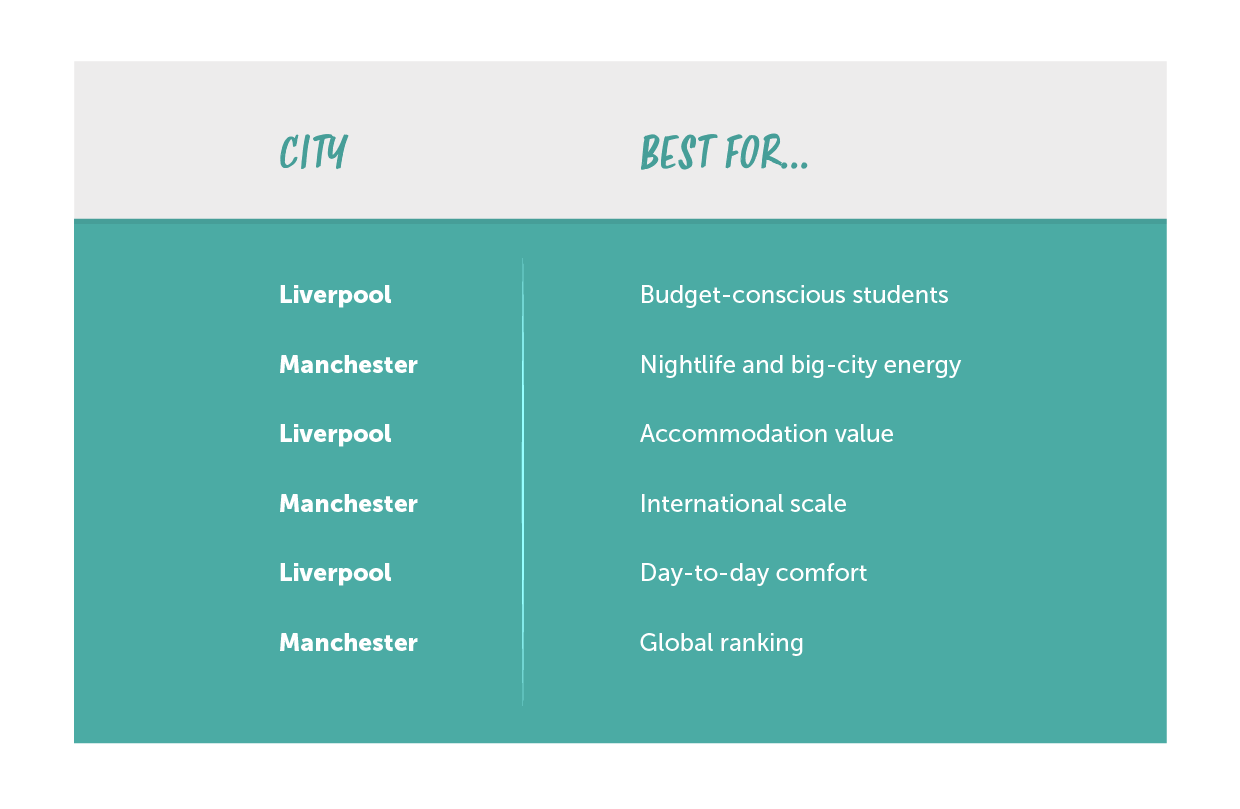
As we’ve already covered for the various aspects of university life, your choice will depend on what you’re looking for in your university experience. Instead of picking an overall winner, let’s look at how Liverpool and Manchester compare for different student priorities.
Budget-conscious students: Liverpool
Liverpool is the stronger candidate for affordability, with lower average student accommodation costs, better value for money, and higher student satisfaction with their accommodation.
International students: Depends on your priorities
There’s no clear winner here; Manchester offers a larger international community and stronger global ranking, while Liverpool provides better support for students, with a more manageable city experience and higher scores for wellbeing.
Research-focused students: Depends on subject fit (slight edge to Manchester)
Both unis are strong, research-led Russell Group institutions, so students should consider the strength and research focus of individual courses, faculties, and facilities when deciding. Manchester has a higher QS ranking and stronger international reputation, which may be important for students working in other countries.
Nightlife and city-life students: Manchester
Manchester is likely to appeal to students who want a more energetic city, with more people and more options. It offers a big-city feel, with a large student population, and a busy nightlife scene.
Quieter or community-focused students: Liverpool
Liverpool is a better fit for students who want a more compact, manageable, and community-focused feel at university. If wellbeing and a comfortable day-to-day life are priorities, Liverpool is the better option.
Accommodation-focused students: Liverpool
Liverpool scores better across different accommodation-related metrics, such as value for money, neighbourhood noise, and shared social and study spaces. For students who are looking for a smoother experience, Liverpool has the advantage.
Overall, choose Liverpool if your priority is affordability, comfort and a smoother day-to-day student experience. Choose Manchester if your priority is scale, nightlife, global profile and the feel of a larger city.
Final Verdict: Liverpool or Manchester?#
On the whole, Liverpool and Manchester offer a great student experience, with both scoring highly in our overall StudentCrowd scores. However, they do suit different priorities, so the better option will depend on what you want as a student.
Liverpool looks to be the stronger option for students who want better value, higher accommodation satisfaction, stronger support and a smoother day-to-day living experience. Manchester, on the other hand, may be the better option for students who want scale, nightlife, a larger international community and the profile of a globally recognised university city.
If affordability, comfort and practical student living are a bigger consideration, Liverpool may be the better fit. If you are looking for a bigger city, a larger student population and more urban energy, Manchester may be more appealing.
Choosing your university (and the city you’ll live in for the next three years) is a big decision. Before making your decision, we strongly recommend reading StudentCrowd reviews and comparing student accommodation options in both cities. If you’re already a student in Liverpool or Manchester, consider leaving a review to help future students make their choice!